CBW Circuit Breakers Configuration Guide

Line voltage thermal circuit breakers are powerful circuit protectors that come in many shapes and sizes. With thermal protection but not magnetic protection, they are built to protect against overloads only — they do not protect against short circuits. Because of this, line voltage circuit breakers must be used in conjunction with a fuse that provides short circuit protection. CBWs are UL 1077 listed. To learn how UL 1077 differs from UL 489 breakers, see our UL 489 vs. UL 1077 comparison.
The "Line Voltage" part of the name means that these circuit breakers operate at 125VAC or 250VAC (or below) and are commonly used for applications where the product is plugged into utility power and/or has high current requirements. These applications might include vending machines, industrial controls, factory automation, telecom equipment, and motor home appliances. They are also rated 32VDC and offer UL 1500 Ignition Protection, ideal for Marine Grade Applications.
At OptiFuse, we provide a variety of configuration options for line voltage circuit breakers, including terminal types, bushing materials, and hardware accessories to meet your application’s requirements. Popular models like the CBW57, CBW58, and CBW68 series offer this versatility, making it easy to tailor each breaker to your needs. For comprehensive guidance on choosing the right electrical parameters for effective overcurrent protection, see our Circuit Protective Device Selection Guide for complete context.
Terminals Configuration
Our line voltage circuit breakers can be designed with terminals in a variety of styles. Terminal options include Quick Connect tabs and screws with or without 90-degree bend or a combination.


Bushing Styles
We offer different bushing styles for all line voltage circuit breakers, ranging from plastic or metal bushing constructions, to M11, M12, or 3/8” thread styles. An automatic reset option with no bushing at all is also available.
Button Color
The buttons on these breakers can be customized by color and can even include the amperage of the part in text. This allows for color coordination and easy amperage identification.

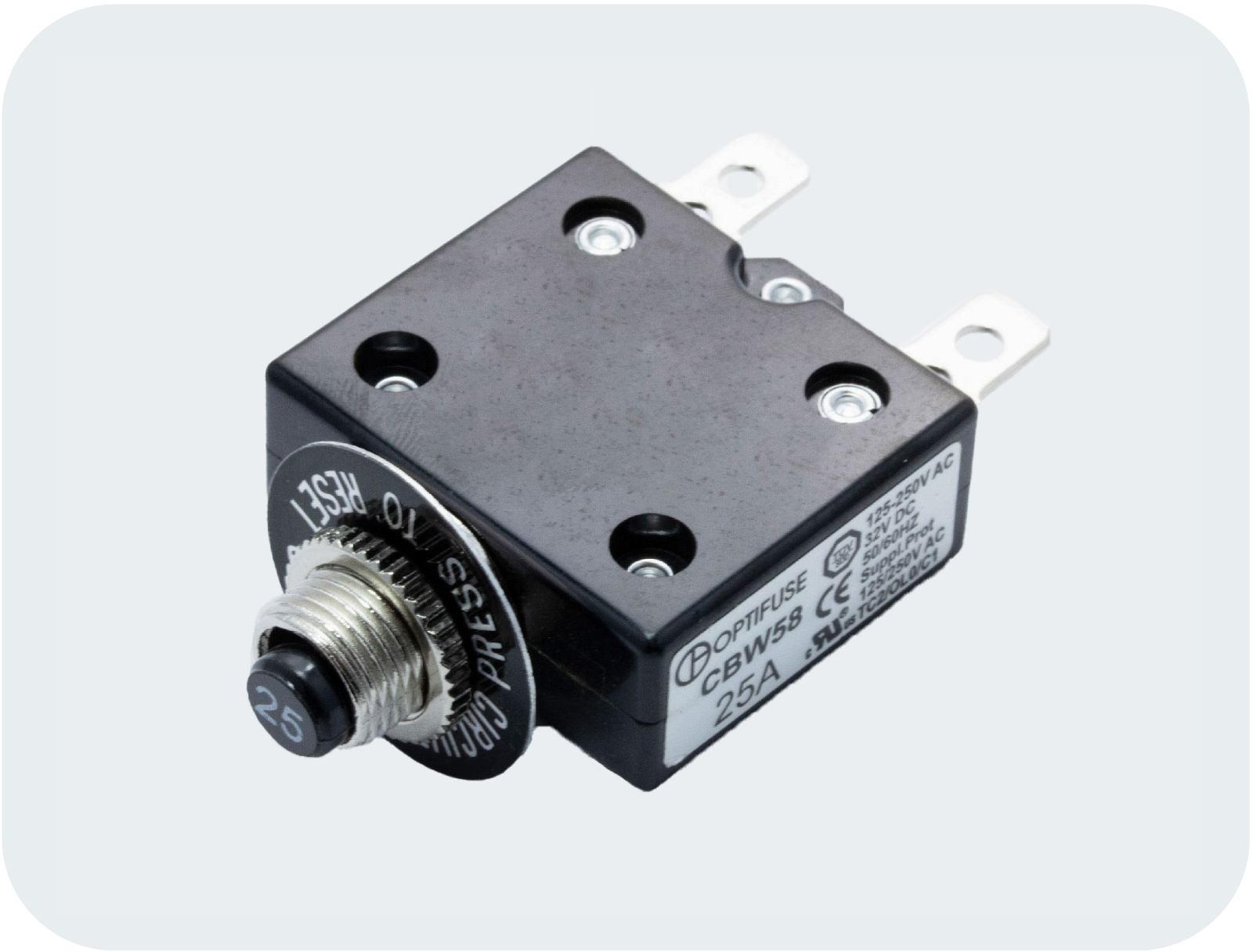
Name Plate
Name plates are available to add onto the parts identifying circuit breakers. There are multiple color options for the name plate. This option makes it easier for users to tell the device apart from others, as well as for how to reset it after it trips.
Nut Type
Depending on the desired bushing, hex or ring nut designs are available for CBW circuit breakers, built of either metal or plastic.


Splash-Proof Boot
Splash-proofing is available for most bushing styles; this better protects the device from the elements in applications that may expose it to harsh environments.
Samuel Kenny, Product Manager at OptiFuse, leads the development of advanced circuit protection products for automotive, marine, and industrial sectors. He designs custom solutions and shares expert fuse selection tips on the OptiFuse Blog.