Can a 30A 32V Fuse Block Handle 20A 48V? Understanding Fuse Block Ratings

48V systems are increasingly common across applications such as EV accessories, mild-hybrid vehicles, telecom equipment, and e-mobility solutions. This often raises a seemingly straightforward question:
My fuse block is rated 30A at 32V. If I only run 20A, can I use it on a 48V system?
On the surface, the calculation might appear reasonable:
P = I x V
- 30A x 32V = 960W
- 20A x 48V = 960W
Same watts, so it should be fine, right?
Usually, no. A fuse block isn’t rated in “watts.” Its current rating and voltage rating are protecting you from different problems.
Current Rating and Voltage Rating Are Not Interchangeable
30A (Current rating) = Can it carry the load without overheating?
A fuse block’s amp rating is mainly a thermal limit. It’s based on how hot the terminals, bus bars, and housing get during continuous current. That rating depends heavily on the conditions the product was tested under.
- What was the size of the wire feeding the power into the block?
- How was the fuse block mounted?
- Is the block able to be cooled by airflow?
- What was the ambient temperature during the test?
- What does the enclosure look like, if any?
Standards are essential because a “30A” rating is not always evaluated identically across product categories:
- UL 4248 (Fuseholders) commonly uses temperature-rise limits at rated current under defined test conditions.
- IEC 60127-6 (Miniature fuse holders) commonly looks at allowable power dissipation (heat lost in watts) to define current capability. Although we’re not looking at miniature fuse holders, the standard guidelines are very much relevant to this discussion.
That’s why two fuseholders that can look similar can behave very differently once you put them in a real enclosure with real wiring.
32V (Voltage rating) = Can it clear a fault safely at that voltage?
The voltage rating addresses fault conditions, not normal operation. It ensures the fuse block can safely interrupt a fault at the rated voltage, accounting for factors such as:
- Clearance and creepage (spacing through air and across surfaces)
- Dielectric withstand
- Arc resistance / tracking behavior of plastics
- What happens around the fuse when the fuse opens under a fault
Exceeding the rated voltage, particularly in DC systems, increases the risk of sustained arcing or carbon tracking, which can compromise both safety and reliability.
Key Takeaway: Reducing current does not allow you to bypass a fuse block’s voltage rating. Lower current helps with heat, but it doesn’t guarantee safe interruption at a higher DC voltage.
Why 48V Is a Different Animal Than 32V (Especially in DC)
AC has a built-in advantage: the waveform crosses zero repeatedly, which helps arcs extinguish naturally. DC circuits lack this zero-crossing, so once an arc forms, it can persist longer. This places greater demands on the fuse holder or block design, including: spacing, materials, and arc management.
So while 48V doesn’t feel “high voltage,” it can still be high enough to produce dangerous failure modes during interruption events. This is especially true for compact automotive-style blocks that were originally designed around 12V/24V ecosystems. See our AC vs DC voltage blog for more information.
Practical takeaway
When designing circuits on a 48V rail, the safest approach is to select a fuse block or holder rated for 48V DC systems. Components with 58VDC, 60VDC, or 80VDC voltage ratings are typically recommended, depending on the product family. Using a fuse block rated above your system voltage ensures safe fault interruption, arc management, and insulation protection under real-world conditions.
OptiFuse offers several solutions specifically designed for higher-voltage DC applications, including multi-circuit blade fuse blocks that are ideal for 48V accessory distribution panels. These blocks allow engineers to stay within the familiar ATO/ATC blade fuse ecosystem while safely handling higher-voltage DC systems.

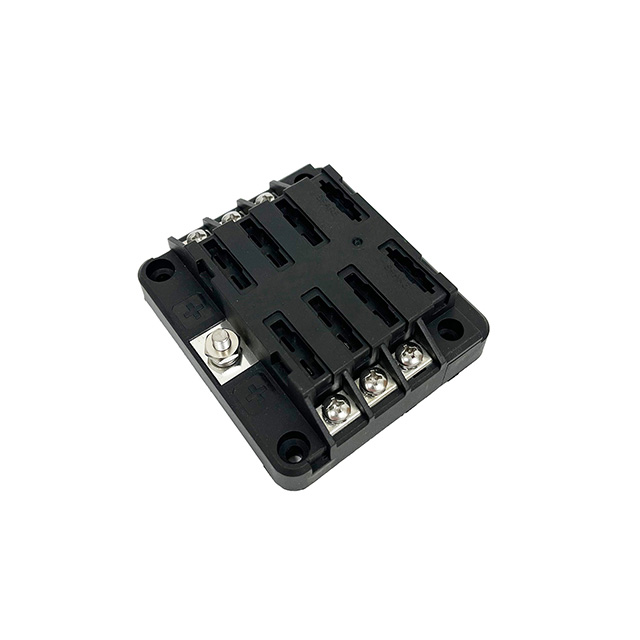


What it pairs with (this matters):
For a 48V rail, always pair your fuse block with higher-voltage ATO/ATC blade fuses, not standard 32V parts. OptiFuse offers options specifically designed for higher-voltage DC systems:
- ANR58-UL (58VDC, UL Recognized): a standard blade fuse designed for higher-voltage vehicle architectures
- ANR80-UL (80VDC, UL Recognized): same familiar ATO/ATC style, but rated 80VDC and built for modern 36–48V platforms
For more inquiries, contact OptiFuse at [email protected] or consult our Fuse Selection Guide for complete context.
Sebastian Castañeda is a circuit protection specialist and technical writer with application-focused experience in technical support and custom protection design. He contributes practical, application-driven insights to the OptiFuse Blog.