Understanding Time-Delay vs Fast-Acting Fuses In Industrial Applications

Designing an industrial facility requires engineers to specify a wide range of electrical equipment. Motors, transformers, pumps, HVAC units, control panels, conveyors, heaters, and automated machinery can all operate within the same building, yet each load has its own current profile and electrical specifications. These specific behaviors oftentimes have their own protection requirements mandated by the NEC.
Within the overall scope of an industrial project, choosing between a time-delay fuse and a fast-acting fuse may seem like a relatively small specification. However, that small decision can have a significant effect on whether equipment starts reliably, or whether a machine remains protected during an overload.
How Fuse Response Affects Circuit Protection
A fast-acting fuse installed on a circuit with significant startup current may open every time the equipment is energized. A time-delay fuse installed where rapid overload protection is required may allow damaging current to flow longer than the protected equipment can tolerate. In either case, the fuse may have the correct ampere and voltage ratings while still being incorrect for the application.
This is where the difference between time-delay and fast-acting fuses becomes important.
The distinction is not simply that one fuse opens slowly and the other opens quickly. It is about how each fuse responds across the complete current profile of the circuit, which includes:
- Normal operating current
- Temporary startup or magnetizing inrush
- Sustained overload current
- High-level short-circuit current
Understanding these response characteristics helps engineers avoid nuisance fuse openings and costly commissioning delays.
OptiFuse Industrial Fuse Options
For a broader overview of UL categories, branch-circuit protection, and supplementary protection, see our article on Understanding Industrial fuses.
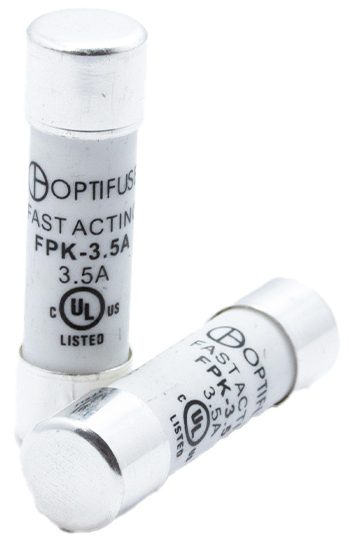
Midget Fuses
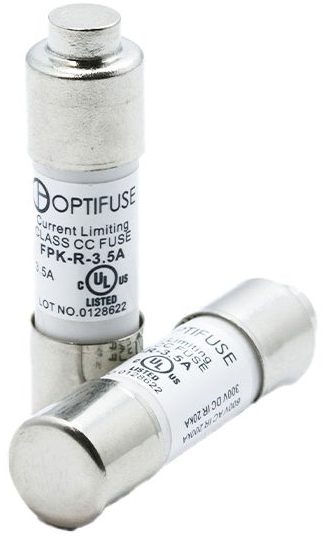
Class CC Fuses
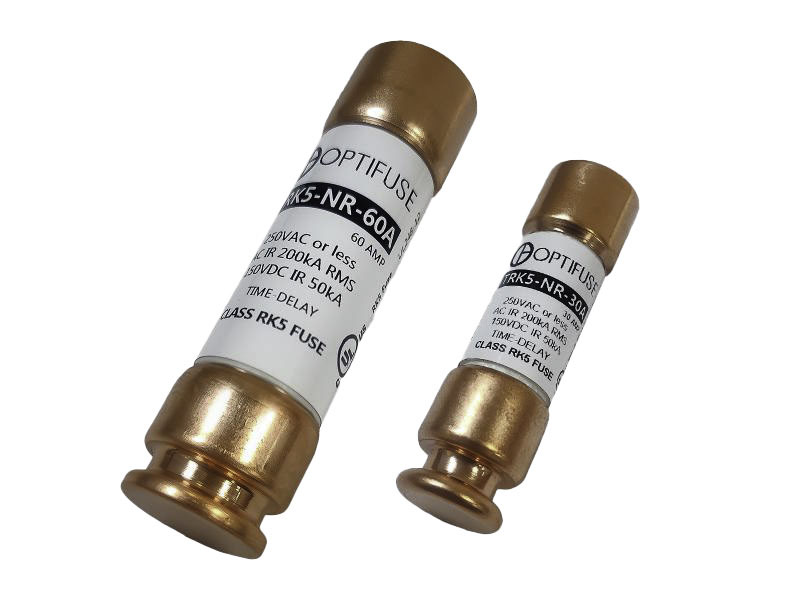
Class T Fuses
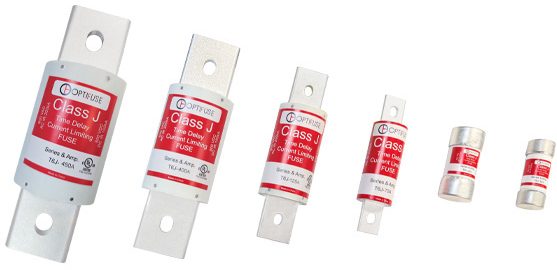
Class J Fuses
- T6J: dual-element time-delay Class J fuse for industrial feeders, motors, and transformers

When to Use a Time-Delay Fuse
A time-delay fuse is typically used when the protected equipment has a normal, temporary surge of current during startup. This surge may be higher than the equipment’s running current, but it does not necessarily indicate a fault.
Common applications for time-delay fuses include:
- Motor circuits, pumps, and compressors
- Transformers
- HVAC rooftop units and condensing units
- Equipment with temporary inrush current
For example, a motor may draw several times its normal running current while it accelerates. A transformer may draw magnetizing inrush when it is first energized. A compressor in a rooftop unit may also draw elevated current during startup before settling into normal operation.
In these cases, a fast-acting fuse may open even though the equipment is operating normally. A properly selected time-delay fuse will allow the inrush to pass without a nuisance opening.
When to Use a Fast-Acting Fuse
A fast-acting fuse is used when the circuit does not have a significant startup surge, or when the protected equipment needs a quicker response to overcurrent.
Common applications for fast-acting fuses include:
- Lighting circuits
- Resistive heating loads
- Control circuits with minimal inrush
- General branch circuits
- Circuits where a delayed response could expose components to damage
Fast-acting fuses are useful when the normal operating current is relatively stable. Since there is little or no intentional delay, the fuse can open more quickly when current rises beyond the expected operating range.
Comparing Time-Delay and Fast-Acting Fuse Curves
The clearest way to compare time-delay and fast-acting fuses is by looking at their time-current curves.
A time-current curve shows how long a fuse takes to open at different levels of current. The horizontal axis represents current, while the vertical axis represents opening time. As current increases, the fuse generally opens faster.
When comparing a time-delay fuse and a fast-acting fuse of the same ampere rating, the time-delay fuse will usually allow more time in the lower overcurrent region. This is the area where motor starting current, transformer inrush, or compressor startup current may occur.
A fast-acting fuse will typically open sooner in that same region, which can be helpful for circuits without inrush but problematic for equipment that needs a brief startup surge.
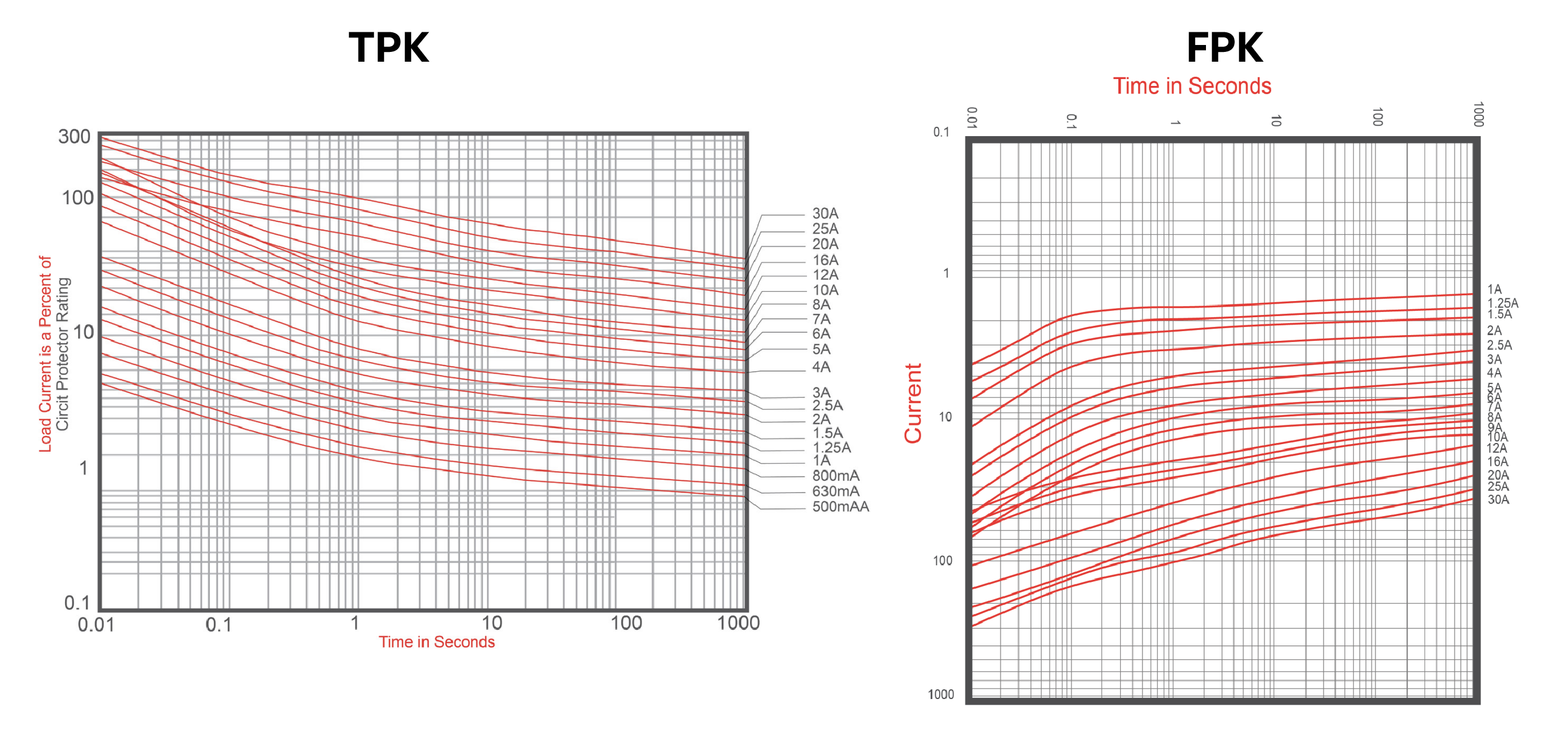
Time-current curve comparison of OptiFuse TPK time-delay midget fuses and FPK fast-acting midget fuses. The time-delay curve allows temporary inrush current for inductive loads, while the fast-acting curve opens sooner under lower overcurrent protection.
In the high-current short-circuit region, the curves may become much closer. This is why a time-delay fuse should not be thought of as “slow” under every condition. Its delay is mainly intended for temporary overloads and inrush, not for allowing a severe fault to continue.
For more information on how to read a time-current curve please read our How to Read a Time-Current Curve For Fuses blog.
Choosing the Right Fuse for the Application
The table below provides a simple way to compare where time-delay and fast-acting fuses are typically used in industrial applications. These are general guidelines, and final fuse selection should always be based on the following: equipment nameplate, circuit voltage, available fault current, fuse class, interrupting rating, and the fuse’s time-current curve.
Motor starting
Excellent
Usually not recommended
Transformer inrush
Excellent
May nuisance trip
Semiconductor protection
Usually no
Possible, but high-speed semiconductor fuses may be required
Overload tolerance
High
Low
Short-circuit protection
Yes
Yes
Typical applications
Motors, HVAC, transformers
Electronics, control circuits, lighting
HVAC Disconnects: A Practical Need for Time-Delay Protection
Rooftop units and condensing units provide a common example of where fuse response matters. NEC 440.14 generally requires the air-conditioning or refrigeration equipment disconnecting means to be within sight of and readily accessible from the equipment. This is why a disconnect is commonly installed next to a rooftop or outdoor condensing unit.
The NEC does not require every HVAC disconnect to be fused. However, when the equipment nameplate or manufacturer instructions specify fuse protection, a fused disconnect can provide both the local disconnecting means and the required branch-circuit short-circuit.
Because compressors and fan motors draw elevated current during startup, NEC 440.22 requires the protective device to provide enough time delay for the motor-compressor and other motors to start and accelerate their loads. A properly selected time-delay fuse can ride through this normal inrush while still opening during a sustained overload or fault.
Can a time-delay fuse still protect against a short circuit?
Yes. A current-limiting time-delay fuse can tolerate temporary overloads while still opening rapidly during a high-current short circuit. Its delay applies primarily in the lower overcurrent region.
Is a time-delay fuse always better for a motor?
It is often the strongest choice, but the fuse must still be coordinated with the motor starting profile.
Can I replace a fast-acting fuse with a time-delay fuse of the same amperage?
Not without evaluating the circuit. The replacement changes the time-current response and may permit an overload to continue longer than the protected equipment can tolerate.
Why does a fuse open when a motor starts?
The motor’s starting-current profile may cross the fuse’s time-current curve. The cause could be a variety of different factors: wrong fuse characteristics, undersized fuse, extended acceleration, low supply voltage, excessive mechanical load, or a motor problem.
Can a midget fuse be used for branch-circuit protection?
A typical UL 248-14 midget fuse is supplementary protection and is not automatically a substitute for a UL branch-circuit fuse. The fuse’s listing and intended use must be checked.
For complete circuit protection context, see our Fuse Selection Guide.
For application support or fuse selection help, contact OptiFuse at [email protected]
Sebastian Castañeda is a circuit protection specialist and technical writer with application-focused experience in technical support and custom protection design. He contributes practical, application-driven insights to the OptiFuse Blog.