How to Tell If a Ceramic Fuse Is Blown

To tell if a ceramic fuse is blown, test the removed fuse with a multimeter after safely isolating the equipment from power. An open-circuit reading indicates that the fuse has opened. Because ceramic bodies are opaque, appearance alone cannot confirm whether the internal element is intact.
Can You Tell if a Ceramic Fuse Is Blown by Looking?
Unlike a glass fuse, a ceramic fuse hides its internal element. A blown ceramic fuse can look completely normal, without discoloration or visible damage.
Cracks, damaged end caps, or scorching are reasons to take a fuse out of service, but their absence does not prove it is working. Equipment that will not turn on is another clue, not a diagnosis. Our glass vs. ceramic fuse guide explains the construction differences.
How to Test a Ceramic Fuse with a Multimeter
Step 1: Isolate all power sources and verify absence of voltage with suitable test equipment before touching internal components. Follow the equipment manufacturer’s service procedure. Never use continuity or resistance mode on an energized circuit. Microwave ovens and other equipment with hazardous stored energy require a qualified technician, even when unplugged.
Step 2. Remove the fuse. Take a replaceable cartridge fuse out of its holder. Testing it while connected can produce misleading results because another circuit path may conduct around an open fuse. Leave soldered-in fuse removal to someone qualified for board-level service.
Step 3. Insert the black lead into COM and the red lead into the resistance/voltage jack. Select resistance (Ω) or continuity mode, it varies by multimeter manufacturer. Touch the probes together to confirm a low reading and, in continuity mode, the expected beep.
Step 4. Place one probe on each metal end cap, maintaining firm contact. Read the resistance display. A continuity beep can help, but its threshold depends on the meter.

What Does the Multimeter Reading Mean?
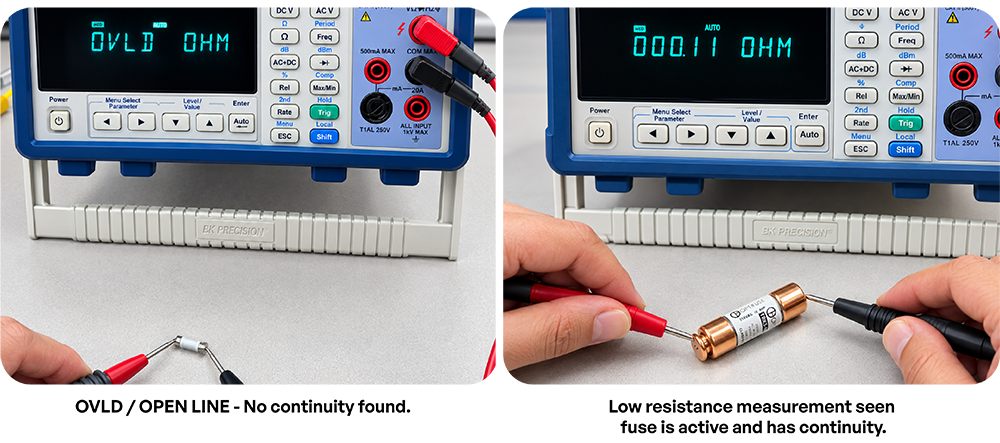
After confirming the meter’s range and probe contact, this means the fuse no longer provides a continuous electrical path and needs replacement.
The element still conducts. However, an intact fuse does not always measure zero ohms. For example, the OptiFuse FCD datasheet lists 4.57Ω for the FCD-250mA. Compare readings with the specific fuse’s documentation listed on our website instead of applying a universal “below 1Ω” rule.
Continuity confirms an electrical path; it does not certify that the fuse is undamaged or suitable for the application.
Choosing the Correct Ceramic Fuse Replacement
Use the equipment manufacturer’s specified replacement or an approved equivalent. Match the current rating and operating characteristics. It’s also important to verify physical fit and required approvals if the application requires it.
OptiFuse’s FCD series provides fast-acting protection in a 5 × 20mm ceramic body. The TCD series uses the same physical format with a time-lag characteristic for applications requiring tolerance of brief inrush currents. Matching dimensions do not make these series interchangeable.
Never bypass a fuse, increase its amperage to stop repeated openings, or substitute glass solely because it fits. If the replacement opens again, stop using the equipment and investigate the cause.
For help comparing replacement requirements, review our tube fuse selection guide or contact OptiFuse at [email protected].
Sebastian Castañeda is a circuit protection specialist and technical writer with application-focused experience in technical support and custom protection design. He contributes practical, application-driven insights to the OptiFuse Blog.